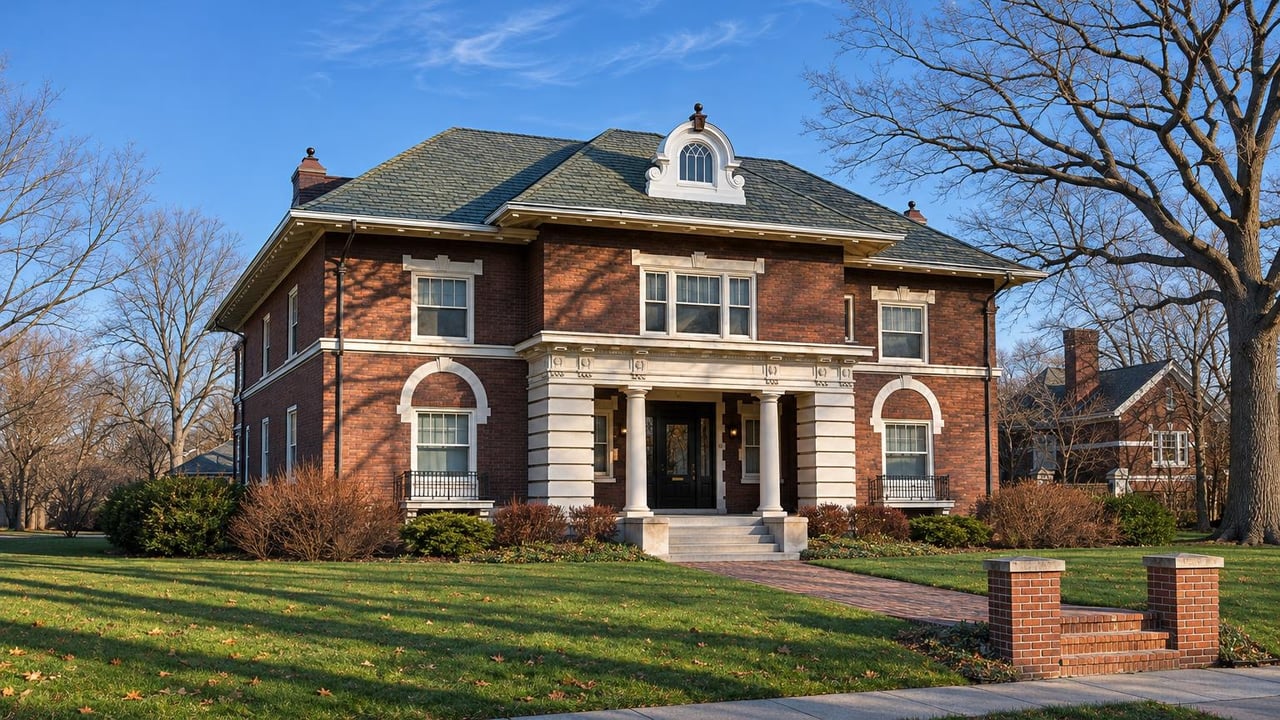
In 2024, two buyers paid $560,000 for a historic house in Indian Village. They already knew it needed a new roof, a new sewer line, updated electrical work and basement remediation. Outlier Media reported that their first property tax bill came to $45,893.40. The assessor had valued the house at nearly $1.3 million.
They appealed to the Property Assessment Board of Review, which lowered the assessed value only slightly. Later, an inspector sent by the assessor's office found errors in the property record, including the wrong square footage and an inflated condition rating. After those were corrected, the City cut their projected bill by nearly $30,000. The roof and sewer line were known costs going in. The tax bill depended on the City's property record, and that record had errors.
Detroit's taxable value gap
Michigan's Proposal A limits how fast a home's taxable value can rise while one owner keeps it. Each year the increase is capped at 5% or the rate of inflation, whichever is lower. Detroit's Office of the Assessor explains that a sale can reset taxable value to the assessed value.
This year shows how fast the two numbers can drift apart. In January 2026 the City reported that Detroit home values rose an average of 10% citywide. Owners who didn't sell had their taxable value increases capped at 2.7%. That 2.7% matches the State Tax Commission's 2026 inflation-rate multiplier of 1.027. The gap builds year after year. Outlier's analysis found that from 2017 to 2025, Detroit's total property value grew from $2.8 billion to $10.1 billion. Over the same period, taxable value for owners who stayed put rose 27%.
Detroit's tax rate makes each dollar of that gap expensive. An August 2026 fiscal analysis from City Council's Legislative Policy Division puts the 2026 total rate at roughly 64 mills for homeowners and 82 mills for non-homestead property. Detroit Assessor Alvin Horhn told Outlier Media that "capping is a problem across the state. It's exacerbated because the millage in Detroit is simply too high."
How far the reset reaches on Indian Village's blocks
Outlier ran the City's 2026 tentative assessment roll through an analysis that estimates each home's tax increase if it sold today. One Indian Village house last sold in 2012 for $198,000. Its estimated annual tax increase on a sale is $66,467. Across the city, the average estimated increase was about $1,403. Even with outliers removed, 1,208 homes would see jumps of more than $10,000. The homes with the largest estimated increases were mostly in Indian Village, Sherwood Forest, Boston-Edison and Palmer Woods.
Outlier's method assumed every home had a principal residence exemption, left out parcels in a Neighborhood Enterprise Zone and dropped the top 1% of uncapping ratios. In 2026, Detroit home values rose for the 11th straight year.
The same gap helps explain why these houses rarely come up
Outlier sorted Detroit homes into five equal groups by their uncapping ratio and counted how many sold between January 1, 2023 and December 31, 2025.
| Uncapping group, 2026 roll | Share of homes sold, 2023–2025 |
|---|---|
| Lowest 20% | 36.96% |
| Low-mid | 5.27% |
| Middle | 3.02% |
| High-mid | 2.58% |
| Highest 20% | 2.49% |
Outlier calls the analysis imperfect. The pattern still matched what market participants described. Outlier reported that real estate professionals across Detroit see homes with large projected increases sitting on the market or taking price cuts.
The pattern suggests that some of the neighborhood's long-held housing stays off the market partly for tax reasons.
The bill is built from a record, and the record can be wrong
The $30,000 correction in the opening story came from facts about the house, not a lower market opinion. The square footage and the condition rating were wrong. The City provides these public tools:
- The City's Parcel Viewer lets you search an address and see basic parcel details.
- The 2026 tentative assessment roll is the public dataset behind Outlier's analysis. It shows assessed and taxable values parcel by parcel.
- The City's new-buyer property tax estimator multiplies the next year's tentative SEV by the current City millage. It leaves out fees, abatements, exemptions and special assessments.
- The Office of the Assessor page now links 2026 valuation sales data, all 2026 transactions and a map of residential Economic Condition Factors by neighborhood.
That last item ties to Mayor Mary Sheffield's first executive order, signed January 30, 2026. It directs the assessor to adopt national IAAO ratio standards, produce a mass-appraisal report twice a year and prioritize updating residential Economic Condition Factors so valuations reflect neighborhood markets.
NEZ Homestead changes the math on eligible parcels
Indian Village appears on City Council's 2021 list of Neighborhood Enterprise Zone Homestead areas in District 5. Council accepted those boundaries on June 15, 2021. The City also has an NEZ map.
According to the City's NEZ Homestead page, the abatement cuts the City of Detroit and Wayne County operating millages in half. For most homeowners that works out to savings of 15% to 20%. All other millages and fees stay the same.
The program also splits the tax bill in two, one for the land and one for the building, in both summer and winter. Outlier left NEZ parcels out of its estimates.
What is pending, as of late October 2026
Two proposals could change these numbers. Neither was law as of late October 2026.
- House Bill 5872. Introduced by Rep. Ann Bollin, the bill would end uncapping on property transfers starting December 31, 2026. It passed the House 57–46 on May 20, 2026. On June 2 it was referred to the Senate Committee on Government Operations, and that referral was its latest listed action as of late October 2026. The House Fiscal Agency projects a $200 million to $250 million revenue loss in the first year, growing past $2 billion by FY 2035.
- City millage. In her first State of the City address, Mayor Sheffield said she wanted to cut property taxes 30% to 60%. As of Outlier's May report, she had not offered a concrete proposal. Council Member Angela Whitfield Calloway has proposed a resolution setting a goal of cutting the rate by one mill a year for four years. A revised version went to the full Council in September. The fiscal analysis estimates that path would cost $100.6 million in cumulative revenue through FY 2031.
The November 3 ballot will not carry a property tax question. Ballotpedia reports that the AxMITax amendment, which would have prohibited taxes on real property, did not qualify after organizers announced on May 22 that they lacked the required signatures.
Quick answer
When do new assessments arrive? In 2026, notices began arriving in the first week of February, and the review period ran through February 22. Those notices are not tax bills.
This post is general information, not legal, tax or financial advice. Before you rely on any figure here, confirm your own situation with a tax professional, attorney or lender.
For more on Indian Village, contact City Living Detroit. Schedule a consultation.