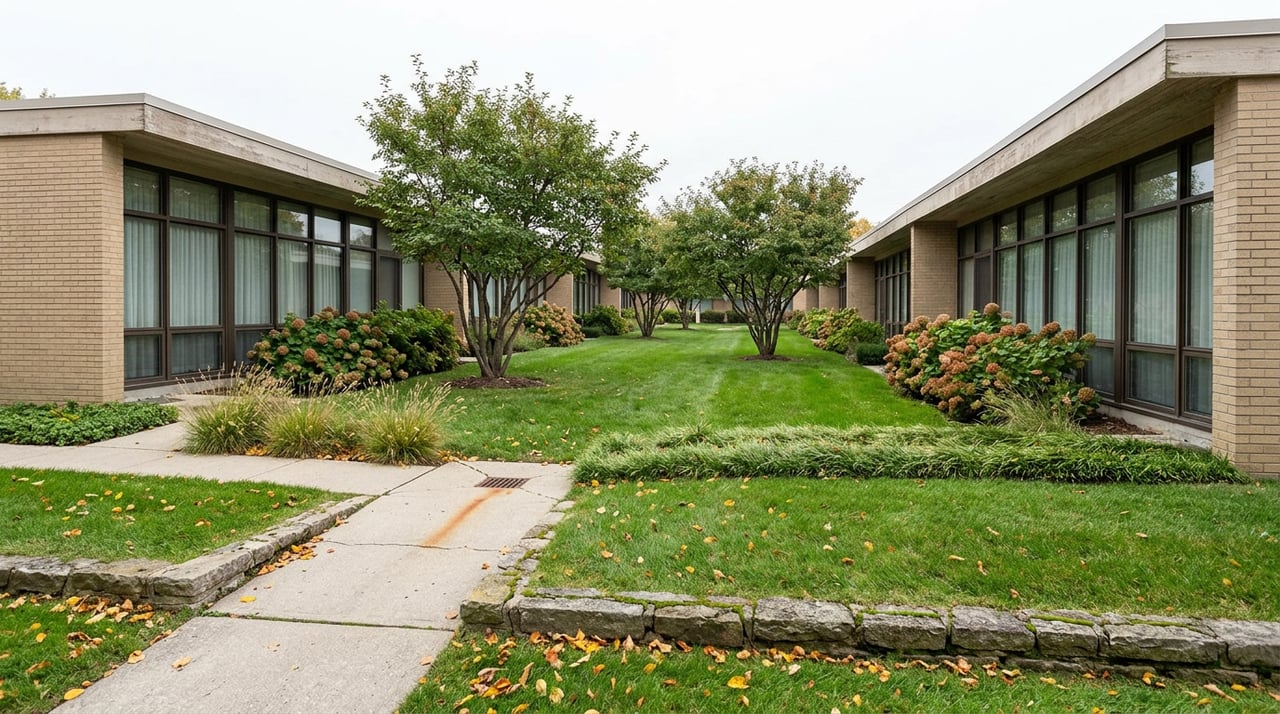
Stand in the Lafayette Plaisance on a September evening and the neighborhood feels self-contained. Mies van der Rohe's townhouses face the grass on three sides, kids run the length of the softball diamond, and the retail row across Orleans hums with the low traffic of people picking up dinner. It reads like a place with its own rhythm, set apart from downtown.
It isn't. Lafayette Park covers just 0.37 square miles and holds about 4,900 residents, and most of what fills a resident's actual week happens outside that boundary, run by organizations that have nothing to do with the neighborhood itself. The Plaisance belongs to the co-ops. The greenway two blocks east belongs to the Detroit Riverfront Conservancy. The garden belongs to a nonprofit called Greening of Detroit. Understanding that these are three separate calendars, not one, is the difference between missing half of what's on and actually living here.
A District Built to Be Quiet
Lafayette Park's small footprint isn't an accident of geography. It was designed that way. The northern section, planned in the 1950s by Mies van der Rohe and completed through the mid-1960s with the Lafayette Towers, was built as a superblock: housing turned inward around shared green space, with through-traffic pushed to the perimeter. The district holds 186 privately owned Town House and Court House units, three apartment towers, an elementary school, a small retail district, and the 13-acre Lafayette Plaisance at its center, according to Mies Detroit, the nonprofit that documents the district's history.
The design logic held up well enough that the same office later replicated it in Newark, New Jersey, as the Pavilion Apartments. The description from the project's own design partner, Fujikawa, was blunt: the Lafayette Towers layout "proved to be a practical and economical solution, and Mies saw no reason to change it."
That practicality is exactly why the neighborhood itself is quiet. There's no strip of restaurants inside Lafayette Park competing for foot traffic. What you have instead is a short, functional list: Lafayette Foods for groceries and a deli counter stocked with more than 500 wine and craft beer varieties, Rivertown Market a few blocks off Interstate 375 with a coffee stand and sushi made in-store, Bai Mai Thai for a sit-down dinner, and Detroit Vineyards pouring wine made entirely from Michigan-grown fruit. That's the neighborhood's own calendar. Everything else on a resident's week comes from outside it.
The Greenway That Splits the Difference
The first outside system starts at the Lafayette Street entrance to the Dequindre Cut, one of seven access points along the nearly two-mile greenway that runs from Eastern Market down to the riverfront. The Cut is a former Grand Trunk Railroad line, now a 20-foot-wide paved path with separated bike and pedestrian lanes, murals and preserved graffiti along its walls, and a small exercise area called the Fit Park near the Woodbridge entrance. It's also, per AllTrails reviews, one of the more consistently dog-friendly paths in the city, which matters if your Saturday morning includes a leash.
The Cut's social anchor is the Freight Yard, a beer and wine garden built from nine repurposed shipping containers that opens for the season starting May 30 and runs weekends through the warm months. A short walk north of the Lafayette entrance sits Campbell Terrace, an outdoor stage where the Riverfront Conservancy runs music programming throughout the year. None of this is managed by the neighborhood. It's managed by the Conservancy, and it operates on its own schedule, entirely separate from what the co-ops or Mies Detroit organize inside the Plaisance.
A Third Calendar, Two Blocks Further
Follow the Cut south past Atwater and you land in the Conservancy's second, larger system: Ralph C. Wilson, Jr. Centennial Park and Robert C. Valade Park. This is where the fall's most specific and most temporary offering sits. From May through October 2026, the Detroit Institute of Arts is running its Inside|Out program, placing full-size reproductions from the museum's permanent collection along the Southwest Greenway, through Wilson Park, and along the Riverwalk. It's a free, open-air version of the DIA that closes for the season once October ends, and it sits close enough to Lafayette Park that it's a walk, not a trip.
Wilson Park's other draws run year-round rather than seasonally: the William Davidson Sport House, with two full-size Detroit Pistons basketball courts under a covered pavilion, the Delta Dental Play Garden, and a 2.5-acre water garden with winding paths and a dock. Valade Park, just north, keeps its own weekly rhythm going regardless of season. Wise Guys Chess Club sets up every Wednesday evening. Volleyball leagues run Mondays and Thursdays. A no-pressure running group meets Tuesdays, and the same evening slot doubles as a remote-work meetup for anyone who wants a laptop and a river view instead of a desk.
What's Actually on the Calendar Right Now
Strip out the recurring weekly fixtures and here's what's dated and specific between now and the season's turn:
- September 20, 2026 — a fall equinox celebration with Afro Moone at Ralph Wilson Park, 1:00 p.m.
- Through October 2026 — the DIA's Inside|Out reproductions remain up along the Southwest Greenway, Wilson Park, and the Riverwalk before the museum takes them down for the season.
- Every Wednesday — Wise Guys Chess Club at Valade Park, open to all ages and skill levels.
- Weekends through early fall — the Dequindre Cut Freight Yard keeps its beer and wine garden running in the shipping containers, weather permitting.
Lafayette Greens, the neighborhood's own garden a few blocks the other direction, ran its own summer series of free yoga and Pilates classes through August, including a Sip & Taste fundraiser on August 21. That calendar belongs to Greening of Detroit, not the Conservancy, and it's worth checking separately, since volunteer harvest days there tend to continue into fall as the garden beds get cleared for the season.
One Saturday, Stitched Together
The practical result of three separate operators is that no single source tells you everything happening within a ten-minute walk. Here's what threading them together actually looks like on a Saturday in late September:
- Start at Lafayette Foods for coffee and something for the walk.
- Cut through the Plaisance to the Lafayette Street entrance of the Dequindre Cut.
- Walk or bike south toward Atwater, watching for murals under the overpasses between mile markers 0.7 and 1.0.
- Come up at Wilson Park and take the Inside|Out route before the exhibit closes for the season.
- Circle back through Valade Park, where the chess tables and running club will still be setting up if you time it for early evening.
- Finish back at Detroit Vineyards for a glass before heading home.
That loop touches three park systems, two nonprofits, and one city-run greenway, and none of them coordinate a shared calendar. If you rely on just one Instagram account or one neighborhood group to tell you what's happening, you're going to miss the equinox event, or the last weeks of the art walk, or the Wednesday chess table that's been running the whole time two blocks from your door.
Lafayette Park's own footprint stays small on purpose. That's the point of the superblock design and the reason the Plaisance still feels calm on a weeknight. But the neighborhood's actual social life happens at its edges, run by people who don't answer to the co-ops or to each other. Knowing where those edges are, and who's programming them this particular week, is most of what it means to actually live here instead of just residing here.
If you're weighing what it's like to call this stretch of the city home, on a longer timeline than one fall calendar, City Living Detroit works this neighborhood and the historic districts around it every day. Schedule a consultation when you're ready to talk specifics.